
Cape Peninsula University of Technology (CPUT) has ordered an immediate shutdown of all campuses and residences following escalating protest action and structural fires.
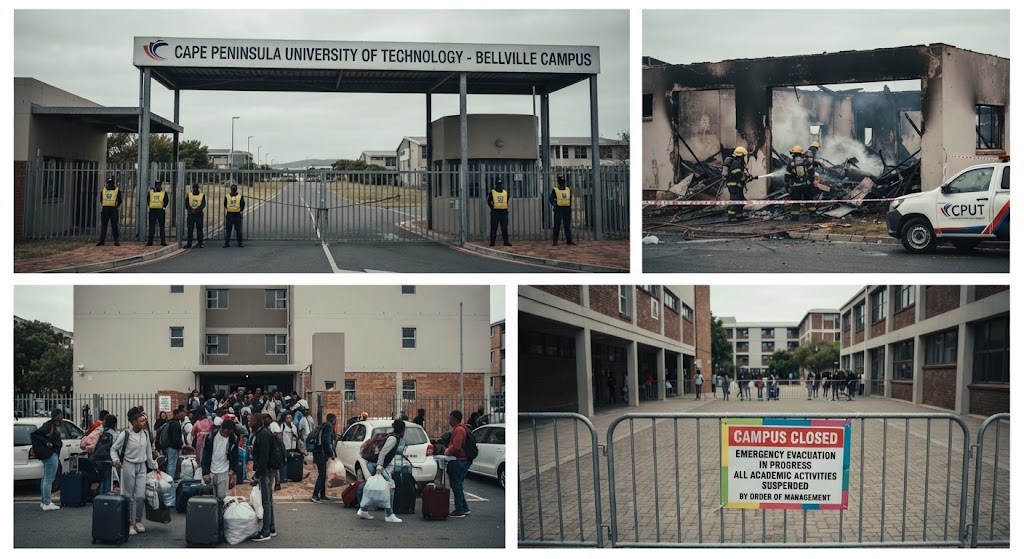
The Cape Peninsula University of Technology (CPUT) has ordered an immediate and total shutdown of all its campuses, coupled with an urgent emergency evacuation of all student residences. The drastic measure follows a night of heightened tension and a destructive arson attack at the university’s Bellville campus, where the historic Old Education building was targeted by flames.
University management confirmed that academic activities have been suspended with immediate effect, leaving thousands of students scrambling to vacate university housing within a strict 24-hour window. The sudden escalation marks a critical turning point in ongoing student demonstrations centered around institutional fee policies and financial clearance rules.
The Catalyst: Arson Attack at the Bellville Campus
The immediate trigger for the sweeping evacuation directive was a severe security breach on Monday evening. Emergency services and fire officials rushed to the CPUT Bellville campus after flames engulfed the Old Education building.
While initial reports confirmed that no injuries or fatalities were recorded during the blaze, the structural damage and clear threat to human life prompted an emergency response from executive management.
- The Incident: The burning of the Old Education building.
- The Response: Immediate deployment of municipal fire services and an emergency security lock-down.
- The Fallout: Zero tolerance from management regarding the destruction of institutional infrastructure.
In an official communique issued to the university community, CPUT management did not mince words regarding the severity of the crisis.
“Continued violent disruptions, torching of buildings, and malicious attacks on institutional infrastructure, have forced university management to close all campuses until further notice and immediately evacuate the residences,” the institution stated.
Management emphasized that while the right to protest is acknowledged, the actions of a faction of unruly individuals had crossed the line into malicious criminality, making normal operations untenable.
Strict 24-Hour Evacuation Order for Student Residences
Thousands of students living in university dormitories were handed a strict 24-hour deadline to vacate campus premises.
As part of the emergency lock-down protocol, all students residing in CPUT campus housing units were instructed to pack their belongings and evacuate the premises.
- Evacuation Deadline: Students were given until Wednesday afternoon to completely vacate all rooms.
- Affected Areas: All student housing across CPUT footprints.
- Operational Status: Residences are completely closed to occupants until further notice.
The rapid turnaround time left many students facing logistical challenges, though student leaders and institutional bodies worked to coordinate safe departures. University authorities noted that the extreme measure was vital to safeguard students from becoming collateral damage in an increasingly volatile environment.
Root Causes: Protests Over the R4.2 Billion Debt Recovery Plan
To fully understand the current emergency evacuation, one must examine the underlying tensions that have gripped CPUT over recent weeks. The unrest is fundamentally tied to student resistance against the university’s proposed Draft Financial Recovery Plan, designed to tackle a staggering R4.2 billion institutional debt burden.
Key Student Grievances:
- Upfront Financial Clearance: The new framework seeks to eliminate traditional debt pledges, requiring students to settle a significant portion of historical arrears upfront alongside a mandatory R7,000 registration fee for the upcoming academic cycle.
- Accessibility Concerns: Student representative councils and general assemblies argued that these stringent financial prerequisites would effectively lock thousands of financially vulnerable and low-income students out of the higher education system.
- Escalating Demonstrations: Peaceful memorandums and mass meetings rapidly morphed into disruptive campus action, halting lectures and drawing in various student political formations across multiple regional campuses.
Although CPUT management subsequently withdrew the contentious draft financial plan in an attempt to cool tensions, localized friction, sporadic clashes, and infrastructure sabotage persisted, culminating in the Bellville campus arson attack.
Impact on Academic Schedules and Remote Operations
| Operational Area | Current Status (As of August 2026) |
| Academic Lectures | Suspended completely with immediate effect |
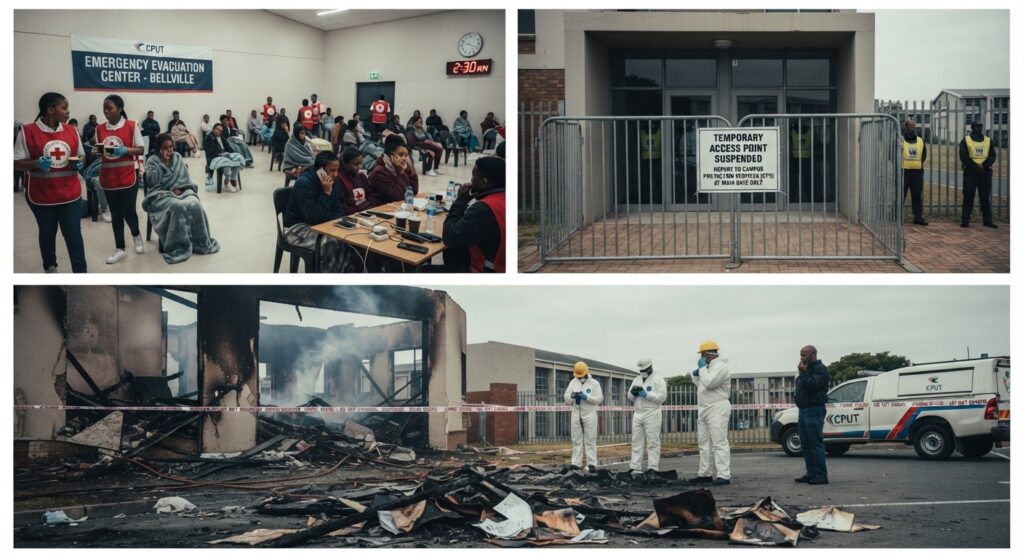
| Campus Access | Closed entirely to students and non-essential visitors |
| Staff Members | Instructed to transition to remote work from home |
| Essential Services | Limited to skeleton crews and authorized support staff only |
With all campuses locked down, the university’s academic calendar faces unprecedented disruption. Management has assured stakeholders that remote communication channels remain active, and administrative personnel are evaluating strategies to salvage the academic year once safety guarantees can be re-established.
Broader Context of South African Higher Education Unrest
South African tertiary institutions continue to grapple with delicate balances between institutional financial sustainability and student access.
The crisis at the Cape Peninsula University of Technology mirrors broader systemic pressures facing South Africa’s tertiary education landscape. Universities across the country frequently find themselves caught in a complex dichotomy:
- The Need for Financial Viability: Accumulating institutional debt, historic fee dropouts, and unpaid state subsidies threaten the long-term operational survival of public universities.
- The Imperative of Social Justice: Millions of students rely on financial aid schemes (such as NSFAS) or flexible payment structures to bridge the gap toward social mobility through education.
When structural economic pressures collide with rigid administrative policies without breakthrough compromises, campuses routinely become flash points. The CPUT emergency evacuation serves as a sobering reminder of the fragile state of campus security when dialogue breaks down into violence.
Looking Forward: Path to De-escalation and Reopening
As the dust settles on the immediate evacuation phase, attention shifts toward what comes next for CPUT. University executives have reiterated that the institution remains open to constructive, peaceful dialogue with student leadership structures, provided that conditions of absolute safety and respect for the law are restored.
- Priority One: Ensuring total headcount safety and securing damaged infrastructure.
- Priority Two: Restructuring financial recovery frameworks in consultation with broader stakeholder inputs to address debt sustainably without compromising access.
- Priority Three: Formulating a phased academic catch-up plan to ensure students can eventually complete their qualifications. businesstech.co.za
For now, the university community waits in limbo as CPUT navigates one of the most turbulent chapters in its recent history. Students, parents, and staff are urged to monitor official CPUT communication channels for verified updates regarding future campus access dates and remote learning continuation strategies.