
Why R500k Is the New Wall for Car Buyers in South Africa (2026)
In this guide:
- The wall nobody budgeted for
- Why new cars got this expensive
- Where the used market picked up the slack
- What a car actually costs once you drive it off the lot
- New or used: how to actually decide
- Buying smart on either side of the wall
- FAQ
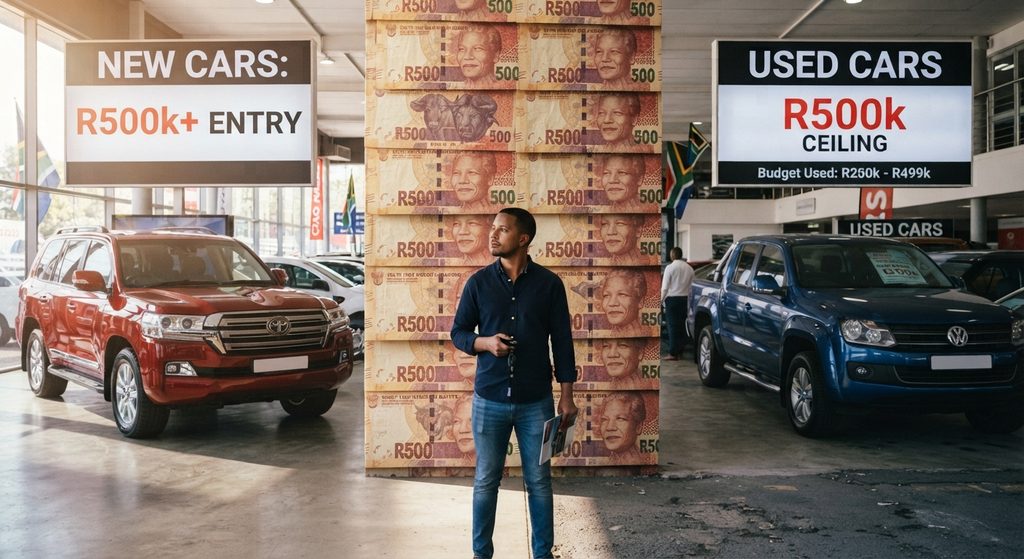
Ask any car shopper in South Africa what their budget is, and you’ll hear the same number more often than any other: R500,000. Not because it’s a round, satisfying figure to say out loud, but because it has become the line where affordability quietly runs out. Go above it, and you’re suddenly negotiating with a bank, a balloon payment, and a repayment term stretching past your next two birthdays. Stay below it, and your options narrow fast — especially if “new” is non-negotiable.
This isn’t a niche problem for luxury buyers. It’s the everyday reality for teachers, junior admin staff, artisans, and young professionals across Gauteng, the Western Cape, and KwaZulu-Natal who need a reliable car to get to work, not a status symbol. So why has half a million rand become the ceiling rather than a comfortable mid-range budget, and what should you actually do about it?
The wall nobody budgeted for
A decade ago, R500,000 bought genuine choice: a well-specced family sedan, a small SUV, or a double-cab bakkie with room to spare in the budget. Today, that same amount barely covers the average new passenger car in South Africa. Industry-aggregated pricing data compiled from naamsa (the Automotive Business Council) and Lightstone put the average transaction price for a new passenger car at roughly R370,000 — and that’s before options, on-road costs, and the gap between a dealer’s advertised “from” price and what actually leaves the showroom.
That R370,000 average masks how quickly things escalate once you move past the absolute entry level. A mid-spec family SUV, a double-cab bakkie, or anything with the safety and infotainment features buyers now expect as standard pushes straight past R500,000 without trying hard. The wall isn’t imaginary — it’s where the median South African household income intersects with what a bank is willing to approve on a 72-month term.
Why new cars got this expensive
Several forces converged to move this line, and none of them are going away soon:
1. Rand volatility and import content
Most vehicles sold in South Africa are either fully imported or built locally with a high percentage of imported components — engines, electronics, and safety systems in particular. Every dip in the rand against the dollar, euro, or yen feeds directly into sticker prices within a model cycle or two.
2. Tightening safety and emissions specifications
Features that were once optional extras — multiple airbags, stability control, reverse cameras, and increasingly, advanced driver-assist systems — are now standard across most new models sold locally. That’s good news for road safety and terrible news for entry-level pricing.
3. A genuine sales rebound
Contrary to the “nobody can afford anything” narrative, the new-vehicle market actually had a strong run. Total vehicle sales climbed to 58,060 units in March 2026, up from 53,380 the previous month, continuing a recovery that pushed 2025 sales to their strongest level in years. Manufacturers with pricing power in a growing market have little incentive to discount aggressively.
4. Interest rates that are easing, but not gone
The SARB held its repo rate at 6.75% at its early-2026 meetings, which keeps prime lending at roughly 10.25%. That’s meaningfully better than the 11.75% peak of the previous cycle, but vehicle finance is still typically priced at prime plus 1–4%, depending on your credit profile and deposit — so the “cheaper repayments” story only goes so far.
Video: first-time buyer lessons that apply directly to anyone shopping near the R500k line.
Where the used market picked up the slack
This is exactly why the used market has become the default entry point for most South African buyers rather than a fallback option. Used-vehicle purchases now outnumber new-vehicle purchases nationally, and financing data backs this up: the ratio of used-to-new vehicle finance applications climbed sharply, with nearly half of all pre-owned purchases now financed at an average deal size well under the new-car average.
The sweet spot buyers are chasing is vehicles between three and five years old. This band currently represents close to 44% of used listings nationally, and for good reason — it’s the point where a car has already absorbed the steepest chunk of depreciation (often a quarter to a third of its original price) while still offering modern safety features, usable factory warranty in many cases, and mileage that hasn’t yet crossed into “worry zone” territory.
There’s also a newer dynamic reshaping this segment: brands that entered South Africa aggressively over the past few years are now filtering into the used market as three-to-four-year-old vehicles, often carrying long remaining warranties. That extra supply is applying real downward pressure on used pricing across the board — good news if you’re shopping below R500k and can be flexible on badge loyalty.
A well-chosen three-year-old car with full service history can deliver most of what a new one offers, at a fraction of the depreciation hit its first owner already absorbed.
What a car actually costs once you drive it off the lot
The instalment is the number everyone fixates on, and it’s also the number that hides the real damage. Once you add fuel, comprehensive insurance (compulsory for any financed vehicle), maintenance, licensing, and the interest sitting quietly on top of the principal, the true monthly cost of car ownership in South Africa has climbed well past what most repayment calculators show upfront — commonly landing somewhere between R9,300 and R11,700 a month once everything is accounted for, depending on the vehicle segment.
That single fact should reshape how you approach the R500k line. Financial guidance from lenders in this space is consistent on one point: total transport costs, not just the repayment, should stay within about 30% of your take-home pay if you want breathing room for the rest of your budget. For a modest financed hatchback, that generally means a take-home income of at least R20,000–R30,000 a month to sit comfortably — a threshold that immediately explains why so many South Africans are priced out of “new” long before they hit the R500k figure itself.
| Vehicle age band | Typical market position | Best suited to |
|---|---|---|
| Brand new | Full warranty, highest depreciation in year one, highest finance amount | Buyers who can put down 10–20% and want zero mechanical risk |
| 1–2 years (demo/ex-fleet) | Near-new spec, first depreciation hit already absorbed by original owner | Buyers wanting modern features without the new-car premium |
| 3–5 years | Sweet spot: steepest depreciation gone, often still under warranty | Most value-focused buyers around the R500k mark and below |
| 6+ years | Lowest purchase price, rising maintenance risk without service history | Cash buyers with a trusted mechanic and a smaller budget |
New or used: how to actually decide
There’s no universal right answer here, but there is a more useful question than “new or used?” — and that’s “how fast does this specific vehicle lose value, and does financing it even make sense at current rates?” High-retention brands with a long, largely unchanged model cycle hold their value far better across the first five years than vehicles known for heavy depreciation, which changes the maths on whether buying new is actually wasteful or whether it’s a reasonable long-term hold.
A few practical filters worth applying before you commit either way:
- Check the resale reputation of the specific model, not just the brand — depreciation curves vary wildly even within one manufacturer’s range.
- Get the full service history on any used vehicle, and be willing to walk away without one, no matter how good the price looks.
- Run the total cost of ownership, not just the sticker price — insurance quotes differ significantly by model, and that gap compounds over a 60–72 month term.
- Treat a balloon payment as debt, not a discount — it lowers your monthly instalment but you still pay interest on it every month, and you owe the lump sum eventually.
- Use your deposit strategically — even a 10% upfront contribution can shave meaningful basis points off your quoted rate and cut total interest substantially.
Video: dealership red flags to check before signing, whether you’re buying new or used.
Buying smart on either side of the wall
If you’re determined to stay under R500,000, the used 3-to-5-year segment remains the most rational place to shop right now — supply is improving as trade-ins from the stronger new-car sales cycle filter through, which historically pushes used pricing down rather than up. If you’re set on buying new, the smartest move isn’t chasing the cheapest sticker price; it’s negotiating the full deal — trade-in value, extras, and interest rate together — and timing your purchase around month-end or quarter-end, when dealers chasing targets tend to have more room to move.
Wherever you land, the R500k figure itself matters less than what it represents: the point where impulse has to give way to a proper affordability calculation. Work out your real monthly transport budget first, including insurance and fuel, and let that number — not the price tag on the windscreen — decide what you can responsibly drive home.
Frequently asked questions
Is R500,000 actually enough for a new car in South Africa in 2026?
It’s enough for an entry-level new car, but not for much beyond that once you factor in extras, on-road costs, and the gap between advertised and actual drive-away pricing. With the average new passenger car sitting close to R370,000, R500,000 gives you room to move up a trim level or a segment — but it stops being “comfortable” the moment you add a bakkie, mid-size SUV, or anything with a bigger engine.
What’s the real advantage of a three-to-five-year-old used car?
Depreciation. A new car loses the biggest single chunk of its value in the first two to three years, largely absorbed by the original owner. Buy at the three-to-five-year mark and you often get a car that still drives, looks, and feels current, with meaningfully less of that value already burned off — sometimes with factory warranty still running.
Should I avoid a balloon payment to keep my instalment low?
Treat it with caution rather than avoiding it outright. A balloon payment lowers your monthly instalment, which can make a car look more affordable than it is — but you still pay interest on that deferred balance every single month, and you’ll eventually need to settle it in cash, refinance it, or trade the car in. It’s a useful tool for buyers with a clear exit plan, and a trap for buyers without one.
How much deposit should I put down on a car?
Where you can manage it, aim for at least 10%. A deposit of this size typically earns a small discount on your quoted interest rate and directly reduces the amount you finance, which compounds into meaningful total-interest savings over a 60-to-72-month term. Every rand you put down upfront is a rand the bank never charges you interest on.
Is it smarter to buy the cheapest car I can find, or the most reliable one?
Reliable, almost every time. The purchase price is only the entry fee — what actually determines whether a car is “cheap” over five years is how often it needs unplanned repairs, how expensive parts are, and how well it holds its resale value. A slightly pricier car from a brand known for low running costs and strong resale will usually beat a bargain-priced car from a brand that depreciates fast and breaks often.
Related reading on LearrnLinkSA
- How to Budget on Your First Salary in South Africa
- Understanding Your Credit Score Before Your First Big Purchase
- Entry-Level Jobs in South Africa Paying Above R15,000 a Month